
How to Become a Licensed Florida Telehealth Provider
Guide to Completing the Out-of-State Telehealth Provider Registration
As a qualified healthcare provider, you can deliver virtual care to patients in Florida as long as you have a Florida telehealth license.
To start practicing as a nonresident telehealth provider in Florida, you need to meet all the state licensing requirements (including appointing a Florida registered agent) and submit a Florida telehealth license application with the Department of Health.
Already know all the requirements and just need a registered agent? We’ve got you! Just head straight over to the order form:
Understanding Telehealth Services in Florida
Telehealth refers to providing healthcare services and information using electronic communication technology rather than providing services in person. For example, video conferencing with a patient in Florida while you’re in New York would be considered providing telehealth services.
Telehealth is becoming a major part of Florida’s robust healthcare economy. Increased demand for online mental health services, chronic disease management, and senior care for the Sunshine State’s rising population of elders all contribute to the growth of this adaptable industry. State lawmakers passed legislation making it easier for out-of-state providers to obtain a Florida telehealth license, so that more patients can access telehealth services.
What healthcare services can be provided via telehealth?
Florida statute 456.47 says that the types of services provided via telehealth include, but aren’t limited to:
- Health administration
- Assessment, diagnosis, and consultation
- Patient treatment and monitoring
- Health-related education between a patient and provider
- Transferring medical data
- Public health services
How do telehealth services work?
Telehealth services can be provided using synchronous and/or asynchronous telecommunications.
Synchronous telecommunications happen in real-time between patients and providers, like video sessions or telephone calls. During synchronous telehealth appointments, providers may observe patient behavior, provide consultations and care—for example, running a physical therapy session—and create care plans while virtually face-to-face with clients.
Asynchronous telecommunications happen when information shared patients and providers is reviewed after it’s been sent. Asynchronous telehealth communications allow patients to access information on their own time and for patients and providers to share information between appointments.
Examples of asynchronous telecommunications include:
- Sharing documents or images before or after appointments
- Reports or forms shared by patients to track progress or symptoms
- Text messaging between providers and patients (includes messaging in a patient portal or on an app)
- Sharing of prerecorded exercises or educational information
Audio-only communications (like phone calls) are included in the state’s definition of telehealth, but emails and fax messages are not.
Who can register as a telehealth provider in Florida?
Florida state law defines the term telehealth provider rather broadly. Telehealth providers include, but are not limited to:
- Physicians
- Nurses
- Pharmacists
- Psychologists
- Mental Health Counselors
- Clinical Social Workers
- Dietitians
- Occupational Therapists
Requirements for Out-of-State Telehealth Providers
To apply to work as an out-of-state telehealth provider in Florida, you must meet the following requirements:

Have and maintain an active, unencumbered license from another state, the District of Columbia, or other U.S. territory

Not have been subject to an investigation, discipline, or revocation of license within the last five years (this includes pending investigations)

Maintain liability insurance coverage or take financial responsibility for telehealth services provided to Florida patients in an amount that is equal to or exceeds Florida healthcare practitioner requirements (at least $100,000 per claim with a minimum aggregate availability of at least $300,000

Agree not to open an office in Florida or to provide in-person health services to patients in Florida

Appoint a registered agent with an office physically located in Florida
Pharmacists must also agree only to dispense medicinal drugs to Florida patients using a pharmacy licensed in Florida, a nonresident pharmacy registered to operate in Florida, or an outsourcing facility.
Why Do Telehealth Providers Need to Appoint a Florida Registered Agent?
You may be wondering: what is a Florida registered agent, and why do I need one? Here’s a brief overview for anyone unfamiliar with registered agents and what they do.

What is a registered agent?
A registered agent is responsible for receiving service of process and other important legal correspondence from the state on your behalf and making sure that these documents get delivered to you in a timely manner (this does not include your regular business mail).
At Florida Registered Agent LLC, we provide same-day digital delivery of your documents. We scan your documents and upload those scans to an online portal so that you can view them immediately.
Why do I need a Florida registered agent as telehealth provider?
Registered agents are usually designated on behalf of a business, like an LLC or corporation. However, Florida law (Section 456.47) requires every out-of-state telehealth provider to appoint a local registered agent like Florida Registered Agent LLC.
This ensures that the state can contact you even though you aren’t physically located in Florida. The state must be able to get in touch with you if you’re involved in a lawsuit or fail to maintain your licensure requirements.
Why Should You Hire Us?

Convenient
You don’t need to impose upon a friend or search for a lawyer located in Florida to act as your registered agent. We’re established, experienced, and ready to act as your local connection in the Sunshine State. We’ll contact you when it’s necessary–you don’t need to keep an eye on us or follow up.

Reliable
You never need to worry about missing an important legal document delivery or updating your registered agent information because we’ve suddenly moved or disappeared. We’re here to stay: we’ve been in business for over a decade and we own our building.

Affordable
We’re committed to charging a fair price. We provide top-notch service with fast and secure digital document delivery for half the price of our national competitors. Why pay $100, $125, or even more every year when you can get the same service for just $49/year?
Plus, get support as your practice grows
We provide more than just Registered Agent Service.
For example, if you decide to form an LLC for your telehealth business, we can help you out with Business Formation Service.
Need to quickly create a website to advertise your telehealth services? We offer web services that include website setup assistance.
Or maybe you need a business phone number? We’ve got you covered with our Phone Service.*
- Business Formation Service
- Mail Scanning Service
- Virtual Office Service
- Domain, Website & Email Service
- Phone Service
- Federal and State Filing Service
* Please be advised that our phone service is not HIPAA-compliant.
How to Fill Out the Application for Out-of-State Telehealth Provider Registration
If you meet all of the requirements for out-of-state telehealth providers, there are two steps to getting your Florida telehealth license: designating a Florida registered agent and submitting your telehealth license application.
After your application is approved, your provider information will be published in the Florida Department of Health’s public list of all registered out-of-state telehealth providers. This is searchable through Florida Health’s License Verification Database.
1. Designate a Florida Registered Agent
Because Florida law requires all out-of-state telehealth providers to have a registered agent physically located in the state, you’ll need to hire a local Florida registered agent or find someone (such as a lawyer) to serve as your registered agent. You must list your registered agent’s name and street address on your Application for Out-of-State Telehealth Provider Registration.
How To Order Our Registered Agent Service
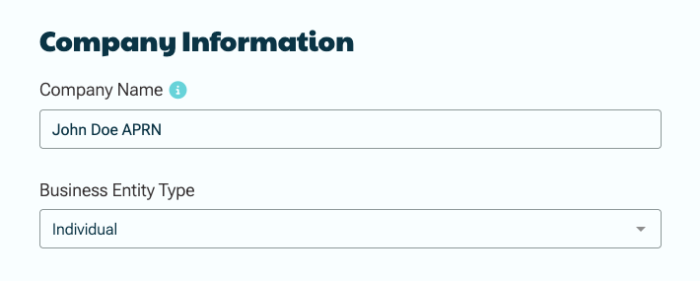
On the order page for our registered agent service, you’ll notice that we ask for your company name and business entity type. This can be confusing because, as an out-of-state telehealth provider, you need registered agent service as an individual.
However, all you need to do is type in your name as your company name and select “individual” from the business entity type drop-down menu:
2. Submit an Application for Out-of-State Telehealth Provider Registration
Once you’ve got a Florida registered agent, you can file your Application for Out-of-State Telehealth Provider Registration. You’ve got a few options for how to submit the application:

Online
The easiest way to file is online using the Florida Health Medical Quality Assurance (MQA) Online Services portal. Create a new applicant account, and when you get to the “Choose a Board/Council” drop-down menu, choose “Out-of-State Telehealth Providers.”

After downloading and completing your application, email it to [email protected].

Download and fill out the Application for Out-of-State Telehealth Provider Registration from Florida Health.
Send your application to:
Telehealth
4052 Bald Cypress Way, Bin C-11
Tallahassee, FL 32399-1708
Information you’ll need to complete your application:
1. Personal information
Name, date of birth, mailing address, gender, and email address (optional, but recommended).
2. License registration information
Your profession, license or certification number, the state or territory where it was issued, its original date of issue, and its expiration date.
3. Social security disclosure
Your full name—first, middle, and last—along with your social security number.
4. Education history
- The school name(s), degree or certificate name(s), and completion date(s) for all relevant training and education related to your license/certification
- The program name(s), specialty area(s), and completion date(s) for all postgraduate training related to your license/certification
- The board name(s), certification or specialty name(s), and completion date(s) for any application board certifications or specialties related to your license/certification
5. Disciplinary history
If you have had any disciplinary action taken against you or had to surrender a license, or if you have any pending investigations or actions being taken against you, you must list the following in relation to these actions:
- Profession
- License Number
- State
- Action Date
- Final Action
- A copy of the Administrative Complaint and Final Order for each disciplinary action listed
6. Financial responsibility
You must acknowledge that you either:
(A) Maintain professional liability coverage that satisfies Florida healthcare practitioner requirements (at least $100,000 claim with a minimum aggregate of at least $300,000)
OR
(B) Have an unexpired, irrevocable letter of credit or escrow account in the amount of $100,000 or more per claim with a minimum aggregate availability of $300,000 or more)
7. Medical malpractice insurance
The name of your insurance provider, your policy limits (per claim and aggregate), and whether or not your policy covers claims arising in the state of Florida.
8. Designation of registered agent
Your registered agent’s name and street address.
9. Applicant signature
Your signature and the date you signed the application.
How to Change Your Registered Agent in Florida
If you already have a registered agent in Florida but want to change agents, you’ll need to file a Change of Registered Agent and/or Registered Office Out-of-State Telehealth Provider with Florida Health. You can use the same form to notify the state if your registered agent’s office address changes. There’s no filing fee.
Here’s what you’ll need to include on the form:
- Your name
- Your address
- Your telehealth registration number
- Your new registered agent’s name
- Your new registered agent’s street address
- Your signature and the date
How to Make Florida Registered Agent LLC
Your New Registered Agent
Want to use us as your registered agent? It’s simple to switch.

Hire us as your registered agent. Be sure to select “individual” from the business entity type drop-down menu and type your own name into the “company name” section.

Terminate service with your previous registered agent.

File a Change of Registered Agent form appointing us as your new registered agent (we also provide Change of Registered Agent form filing service for $50).
Out-of-State Telehealth Provider FAQs
How much does it cost to register for a FL telehealth license?
There is no fee to register as an out-of-state telehealth provider in Florida.
How long does it take for my telehealth application to be reviewed?
According to Florida law, initial applications must be reviewed within 30 days. However, the Florida Board of Medicine Licensing and Registration site lists current review times, which are often much shorter. You can also check your application status using the MQA Online Services portal.
Does my out-of-state telehealth provider registration expire?
Your registration will not expire, and you won’t need to submit any renewal filings. As long as you maintain a registered agent and meet the eligibility requirements, your registration will remain active.
Which professions qualify to register as telehealth providers?
There are many professions in the healthcare field that qualify to register. These are among the most common:
- speech language pathologist
- acupuncturist
- advanced practice registered nurse
- athletic trainer
- audiologist
- behavior analyst
- certified nursing assistant
- chiropractor
- clinical lab personnel
- clinical social worker
- dentist
- dietitian
- electrologist
- emergency medical technician
- genetic counselor
- hearing aid specialist
- licensed practical nurse
- marriage and family therapist
- massage therapist
- medical physicist
- mental health counselor
- midwife
- occupational therapist
- optician
- optometrist
- osteopathic physician
- paramedic
- pharmacist
- physical therapist
- physician
- podiatrist
- psychologist
- psychotherapist
- radiologic technologist
- registered nurse
- respiratory therapist
What if I want to stop providing telehealth services in Florida?
If you no longer wish to provide telehealth services in Florida, you must send a written request to Florida Health stating that you would like to have your telehealth registration status changed to “null and void.” You can mail or email your request.
Can I register with a provisional license?
You cannot register with a provisional license. Provisional licenses have provisions that must be met, such as supervision, and are therefore not considered unencumbered.
Are there exemptions to registration?
There are two exemptions to registration, according to Section 456.47(6):
- If you serve as a consultant to a health care professional who is registered to practice in Florida and who has ultimate authority over the patient’s diagnosis and care
- In response to an emergency medical situation
Do I need to register if I am a multistate license (MSL) provider?
If Florida is a member of the healthcare licensure compact for your license, you do not need to register. For example, Registered Nurses and Licensed Practical Nurses who hold an MSL under the enhanced Nurse Licensure Compact (eNLC) are already eligible to provide out-of-state telehealth care in Florida.
However, if Florida is not a member of the healthcare licensure compact for your license, you must register.
Can I share my registered agent service with another telehealth provider?
Even if you work at the same company, each provider must appoint their own registered agent as an individual. You cannot share the service.
Ready to Start Doing Business in Florida?
Form a Business
$149
+ state fees
Order Registered Agent
$49
/ year